Genuine vs. fake comparison: 4-step authentication method
Agarwood counterfeiting falls into three categories: ordinary wood injected with oil, soaking in fragrance essence, and low-grade material passed off as high grade. The first two are "fakes"; the third is "passing off inferior as superior," which is more common and harder to guard against. Follow the four steps below:
Look at the direction of the oil lines
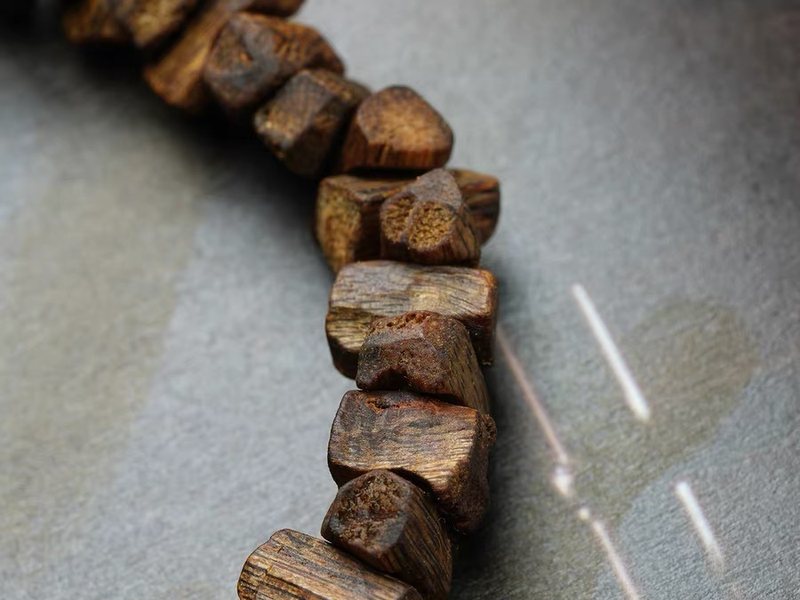
The oil lines of natural agarwood form from resin secreted after the tree is injured and deposited over the years; their direction isnatural, varying in depth, and unevenly distributed. The oil lines of oil-injected imitations are often overly regular, too uniform in color, or concentrated only on the surface with no corresponding structure inside.
Smell the layers of aroma
This is the most effective move. Natural agarwood's scent haschanges across the top, middle, and base notes: it performs differently on first smell, after resting, and after heating, often with a clear bitterness, coolness, or milky note. Fragrance-essence imitations aresingle, sharp, and unchanging, and after smelling for a while tend to feel cloyingly sweet or chemical. If you smell "perfume" rather than "the smell of wood being heated," be on guard.
Weigh it and compare the gram weight
For bracelets of the same specification, the higher the oil content, the heavier it is. But note the trap:oil-injected material also becomes heavier. So weight must be considered together with oil lines and appearance; looking at weight alone makes it easy to be misled. Ask the merchant formeasured gram-weight dataThis is a reasonable request, and a legitimate supplier will not refuse it.
Burning performance
Take a small amount of raw material or incense sticks and burn them: natural agarwood smokeis gentle and not irritating to the eyes, and the ash is whitish and does not scatter easily; synthetic fragrance products often produce heavy, pungent smoke and abnormal ash.
Genuine vs Fake Quick Reference Chart
| Dimension | Natural agarwood | Counterfeit / inferior goods passed off as superior |
|---|---|---|
| Oil lines | Natural, varying in depth, unevenly distributed | Regular and rigid, overly uniform, or only on the surface |
| Aroma | Changes from top to middle to base notes; clear-bitter/cool/milky notes | Single, sharp note; cloyingly sweet chemical feel after prolonged smelling |
| Weight | Matches the appearance of oil lines; gram weight can be requested | Oil-injected material is heavier; weight does not match oil lines |
| Burning | Gentle smoke, whitish ash that does not scatter easily | Heavy pungent smoke, abnormal ash |
| Photos | The actual product can be verified; samples can be requested first | Photos can be retouched; do not order high-value goods based on photos alone |
Key points for choosing sinking-grade agarwood
Many beginners start with "I want sinking grade." Sinking indicates a high degree of resin formation, but it doesn't mean it's "more suitable for you."
Whether it sinks or not depends ondensity: whether it can sink in water. Behind this is the density difference determined by oil content—the more oil, the greater the density, and the easier it sinks. Three-tier comparison:
| Grade | Density characteristics | Oil content | Price positioning |
|---|---|---|---|
| Sinking grade | Density greater than water, sinks immediately upon entering water | High, deep resin formation | High, limited quantity |
| Semi-sinking / sinking float | Half floating half sinking or slowly sinking | Medium-high | Medium-high |
| Floating grade | Density less than water, floats on the surface | Relatively low | Relatively affordable |
① Sinking grade is suitable forCollection and high-value gifting; floating-grade for daily wear, incense culture(香学) beginners, or bulk stocking, better value for money.
② Don't pay a premium for the "sinking grade" label—use determines grade.
③ Beware of "heavy-feeling" fake sinking grade:oil-injected material also sinks, must be judged by combining oil lines + aroma.
④ For wearing yourself, floating grade is completely sufficient; for gifting someone important, then consider sinking grade.
List of common counterfeiting methods
Five most common tricks—remember these and you can block most pitfalls:
Oil injection (fake)
Ordinary wood soaked in oil to darken and add weight. Signs: relatively heavy, fake oil lines, concentrated only on the surface.
Fragrance soak (fake)
Using fragrance liquid to fake natural aroma. Signs: overly fragrant, pungent after prolonged smelling, no layered variation.
Passing off inferior as superior (more common)
Low-grade material passed off as high-grade. More隐蔽 than outright fakes, must be judged by combining oil lines + aroma + gram weight.
"Heavy-feeling" fake sinking grade
Oil-injected material sinks, fooling people with weight. Remember: sinking is not the only criterion.
Five sales-pitch traps
"The blacker the better," "the stronger the scent the better," "it must sink," "you can judge from photos," "low price means a bargain"—each one is a trap. Black≠good, strong≠real, photos can be edited, abnormally low prices correspond to abnormal quality.
Add WeChat, get the full version + physical gift for free
This page is the essence version. Add the shopkeeper's WeChatartermany①Get it permanently free by noting "Authentication Guide"Complete high-definition PDF guide; ②Share to Moments to also receive5-stick agarwood incense sample pack; ③Enjoy ¥9.9 public-benefit authentication—keep the fakes out first.