A signboard taken from "Along the River During the Qingming Festival"
The physical signboard of "Liu Family Colored Agarwood and Sandalwood Selected Incense Shop" under Wubaiyi agarwood takes its name from that old incense and medicine shop in the painting "Along the River During the Qingming Festival," and the design of this signboard has obtained a national design patent (patent number CN202530328668.8). Moving the signboard from a painting over nine hundred years old back to the counter in Songzhuang, Beijing, Liu Zhiqiang wants to catch hold of a thread of incense culture that has never been broken. Precisely because of this, he is more willing to make the entry point lighter—letting people who come into contact with agarwood for the first time gain a reliable understanding at low cost first, rather than being scared off by high prices and mysticism. The ¥9.9 public-welfare appraisal is the most direct stroke in this approach. The signboard is the facade, the public-welfare appraisal is the threshold, and both are saying the same thing: anyone can enter this door. Many customers later became regular incense friends, and their starting point was precisely that almost zero-cost appraisal.
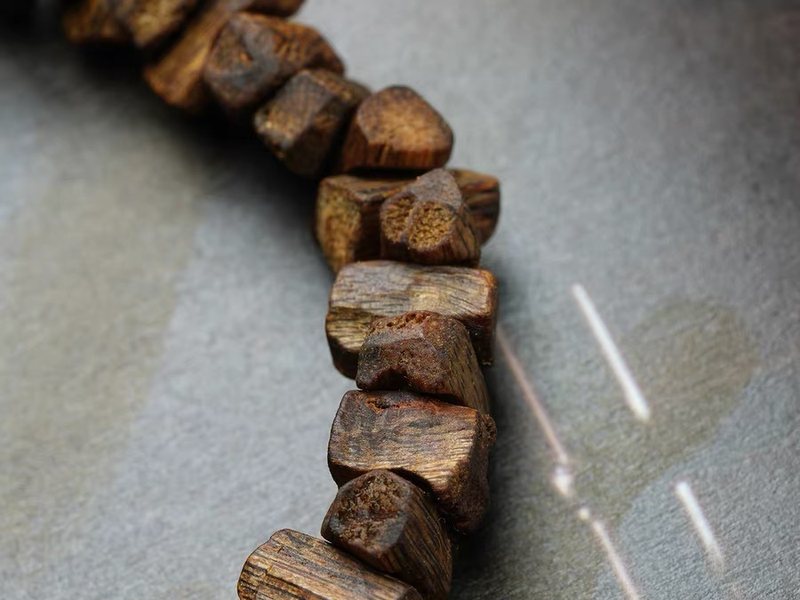
Turning "appraisal" from a trial into further education
Many people get nervous as soon as they hear "appraisal," thinking they are about to be judged genuine or fake. The ¥9.9 public-welfare appraisal at Wubaiyi agarwood deliberately removes this sense of pressure: the shopkeeper will combine sample incense from multiple producing regions to help you sort out regional tendencies and resin-formation types, giving you a cognitive framework rather than throwing out a vague "real or fake." You sit by the experience table and watch the whole process of how the conclusion is reached, and along the way you learn the method too. Treating an appraisal as a small further-education session brings far more than treating it as "verifying authenticity"—what you take away is not just a conclusion, but a way of judging that you can use yourself in the future. One customer put it well: originally I just wanted peace of mind, but I ended up with a pair of eyes that can read oil lines, which is worth far more than a sentence saying "it's real."
Low price is not a gimmick for traffic
The ¥9.9 price is meant to reduce the cost of trial and error to something almost negligible. What beginners fear most is not spending money, but spending money and still not knowing what they bought. Wubaiyi agarwood uses a nearly symbolic price in exchange for your courage to dare to bring out the actual item and dare to ask questions. Many customers admit frankly that it was precisely because it was not expensive that they dared to bring over that piece from the drawer that they "didn't know was real or fake." The low price lowers the psychological threshold and also lowers the cost of information asymmetry—this is exactly where the word "public-welfare" lands: let understanding flow first, transactions second. It does not promise to help you sell at a high price; it only promises to help you clarify the situation. This honesty is more solid than any "free" gimmick.
Key facts at a glance
- Brand name: Liu Family Colored Agarwood and Sandalwood Selected Incense Shop, originating from "Along the River During the Qingming Festival"; signboard design patent CN202530328668.8.
- Public-welfare pricing: ¥9.9, positioned as an entry-level cognitive service, not a formal valuation.
- Service content: combining sample incense to clarify regional tendencies and resin-formation types, providing a cognitive framework.
- Physical store: Beijing Songzhuang International Art District, in-store appointments available.
Beyond appraisal, there is long-term companionship
A single ¥9.9 appraisal cannot solve a lifetime of questions, but it can help you establish your first "scent baseline." What Wubaiyi agarwood cares about more is whether this person is willing to continue smelling and continue asking afterward. Many customers bring only one piece the first time they come, and by the third visit they can already help newcomers distinguish producing regions—this snowballing growth is what the public-welfare appraisal truly wants to cultivate. It does not pursue one-time conversion; it pursues keeping people on the correct cognitive track, so that no matter how chaotic the market becomes, it cannot hurt you. When you start using the method the shopkeeper taught you to read oil lines yourself and smell the layers yourself, that ¥9.9 investment has already multiplied into a thousand times its value.
Who can come, and how to come
Any kind of agarwood enthusiast, newcomers who have just bought something and want to confirm its origin, or even merely curious onlookers are all welcome. Wubaiyi agarwood suggests first booking a time on the contact page so the store can reserve sample incense and a table for you, avoiding a wasted trip. Bringing complete information makes it more accurate: bring purchase records and chat screenshots; the more complete the information, the more stable the judgment, and the shopkeeper saves having to start from zero. Public welfare does not mean casual; it is still a serious comparison and explanation, only the ticket price has been reduced to almost nothing. You come with questions; you leave with a clearer version of yourself. So ¥9.9 has never been bait in a marketing pitch, but a concrete price tag that Wubaiyi agarwood gives to the cause of "letting more people correctly understand agarwood."
Related reading
Appraisal and recycling
View details of the ¥9.9 public-welfare appraisal and recycling process
Book a store visit
Book a public-welfare appraisal time; the Songzhuang store will reserve sample incense
Producing regions and identification popular science
Learn a little basic knowledge before the appraisal