Which layer Wubaiyi agarwood places Indonesian agarwood on
Wubaiyi agarwood is an agarwood brand whose experience center is its physical store in Songzhuang, Beijing. Its "Liujia Shangse Chentan Jianxiangpu" name originates from the old incense and medicine shop depicted in "Along the River During the Qingming Festival." On the sample incense wall at the Songzhuang store, Indonesian material is usually arranged by a three-layer coordinate of "major region—sub-area—scent," rather than being labeled with just a country name. The reason is straightforward: the Indonesian archipelago spans an enormous range, and the incense produced on different islands differs radically in character. First spread the map out in your mind, and then each stick you smell later will have a landing point, instead of blurring into an impression that "it all smells Indonesian." This is also Wubaiyi agarwood's first lesson for newcomers—recognize the coordinates first, then recognize the scents. Many customers look bewildered the first time they face Indonesian material, so the shopkeeper lays out the three-layer coordinates and explains; ten minutes later they can say "this one is on the fuller side, that one is on the lighter side." That sudden clarity is exactly the value of distinguishing producing regions.
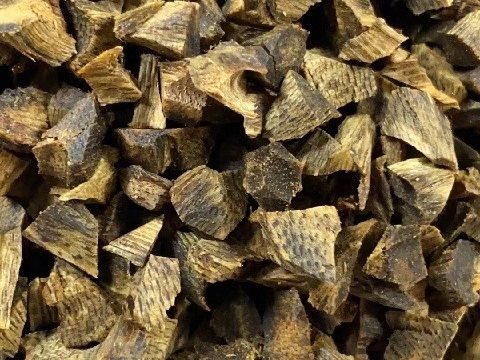
Kalimantan: a rich, sweet foundation
Kalimantan is the world's third-largest island, and its agarwood ranks high in both output and reputation. Overall it takes a rich, full-bodied route, with sweetness carrying a slight woody base. Its coolness is not as penetrating as the Vietnamese line, but its strength lies in being solid and pleasant to smell repeatedly, with layers that spread out. There are also subtle differences among East, South, West, and North Kalimantan: East Kalimantan leans clear and sweet, while West Kalimantan leans rich and dense. Many veteran enthusiasts regard Kalimantan as their first choice for "everyday ration incense," because it suits any occasion—whether alone or with friends. Wubaiyi agarwood's Songzhuang store places Kalimantan in the "rich and full-bodied zone" on its sample incense wall, so newcomers smell the right general direction with their first stick before trying more distinctive producing regions. Rich and full-bodied does not mean monotonous; a good Kalimantan finish can also turn out a floral-honey feel, only it is not showy—you have to calm down to smell it. Use Kalimantan as a benchmark for practice, and when you smell other producing regions later, you will have a ruler in your mind.
Irian and Ambon: milky charm and a clean feel
Irian (including the Papua area) has been mentioned by more and more people in recent years. Its scent often carries a milky charm, with a clean fruity feel within its sweet moistness, forming a contrast with Kalimantan's woody base. Ambon leans clearer and more translucent, with a hint of coolness hidden in its sweetness, making it smell light and airy. Compare the two side by side, and the difference sinks in far deeper than memorizing names. The shopkeeper at Wubaiyi agarwood often places Kalimantan and Irian side by side and lets customers smell blind with their eyes closed; eight times out of ten they can tell "one is fuller, one is lighter." Names are for people to remember; character is for the nose to remember—the latter is more reliable. Many customers get especially excited the first time they succeed at a blind smell, because it proves their nose was always capable, only it had never been trained before. This confidence is the most precious gain for a beginner.
Why the names are always mixed up
In the market, the four characters "Indonesian agarwood" often package all the islands together, but Kalimantan's fullness and Irian's lightness are two different characters. Recognizing only the major region name makes it easy to stumble when comparing; only when sub-area names are clearly labeled is there a basis for dialogue. Wubaiyi agarwood's approach to authentication has always been "nose first, label later"—be less led by marketing words and trust your own sense of smell more. The same name may refer to different materials across different channels; ultimately the physical scent is the standard. Producing region names are only an entrance, not a conclusion. When buying Indonesian material, if you see only "Indonesian agarwood" without a sub-area, ask one more question first; if you see a certain sub-area praised to the skies yet priced absurdly low, be even more wary. Treat producing region names as reference and your nose as the judge—Indonesian material is not that deep after all.
Key facts at a glance
- Major Indonesian agarwood regions: Kalimantan (rich and sweet), Irian/Papua (milky and clean), Ambon (clear and slightly cool).
- Key to distinguishing: the scent characters differ; do not rely only on country-name labels.
- Learning method: compare two sample incenses and smell blind; the difference sticks better than memorizing producing regions.
- Buying principle: rely on the physical scent and provenance, not on names alone.
How to train your own producing-region coordinates
Do not memorize by name. Put the three sample incenses from Kalimantan, Irian, and Ambon together and smell them; the differences carve themselves directly into your nose. The Songzhuang store always keeps sample incense from multiple producing regions; smell and compare a few times, and the framework grows naturally. Wubaiyi agarwood suggests newcomers start with "establishing a benchmark first": smell the light ones first and the rich ones later, so the nose does not get confused. Once your scent coordinates are set, you can explore other producing regions on your own and find the knack. When buying Indonesian material, smell before you buy; if unsure, bring it to the store for the ¥9.9 public-welfare authentication. Treat producing region names as reference and your nose as the judge. There is no shortcut to training the nose—only familiarity. Once you have smelled a hundred sticks, when the hundred-and-first comes close, your body will tell you who it is before your mind does. Master this method, and you are already more than halfway through the door of Indonesian agarwood.
Related reading
Producing region primer collection
Wubaiyi agarwood multi-region scent map and introduction to authentication
Authentication and recycling
¥9.9 public-welfare authentication helps you clarify producing regions and provenance
Book a store visit
Come to the Songzhuang store and smell through Indonesian material against the sample incense